Full disclosure
Nightcap makes this guide, and Nightcap’s TV Ads is the cheaper way at the end of it. The prices for the other products come from their own websites as of October 2026, with links so you can check. Prices change, so look before you buy.
The short version
- Software only, on TVs you own: about $8 to $30 per screen per month. Three TVs is $24 to $90 a month, every month.
- Add a media player: $0 to $200 per TV, once. Some plans include one if you pay for a year up front.
- Full install with new commercial screens: $1,500 to $4,000 per screen, plus the monthly software.
- The cheaper way: use the TVs you have, skip the player, and pay per bar instead of per screen. Nightcap’s TV Ads is $49 a month for the whole bar and comes with the games.
What digital signage means in a bar
Strip away the sales words and digital signage is a TV that shows your stuff instead of someone else’s. Your drink specials. Happy hour. Wing night. The band on Friday. A digital menu board is the same thing with prices on it. An ad rotator or ad loop is the same thing again, cycling through a few posters so each one gets its turn.
Every one of these needs three parts: a screen, something to play the content on that screen, and software to make and schedule the content. The cost is in how you fill those three slots.
What it costs, part by part
1. The screens
If you use the TVs already on your wall, this is $0. Most bars have more TVs than they need and at least one that shows a game nobody picked with the sound off.
If a vendor talks you into commercial displays, expect $800 to $2,500 per screen. Commercial panels are brighter and rated to run all day, which matters for a window-facing menu board in sunlight and matters very little for a TV over the bar that was already running all day anyway.
2. The media player
The media player is the little box that plugs into the TV and plays the loop. Prices as of October 2026:
- Yodeck includes its player free when you pay for a year. Month to month, you buy one.
- ScreenCloud sells its own player; the going rate for a dedicated box is around $150 to $200.
- OptiSigns runs on a Fire TV Stick or similar that you supply, about $30 to $60.
A player per TV also means a player per TV to find a plug for, hide behind the set, update, and reboot when it freezes on a Saturday night. That is the hidden cost nobody puts on the pricing page.
3. The software, per screen, per month
This is the part that quietly adds up, because almost everyone prices per screen.
Swipe the table sideways to see every column.
| Software | Starting price | Three TVs | Player | Free plan |
|---|---|---|---|---|
| Yodeck | $8 per screen per month | $24 a month | Free with an annual plan | Yes, one screen |
| OptiSigns | $10 per screen per month ($9 annual) | $30 a month | Bring your own stick | Yes, with their logo on screen |
| ScreenCloud | $20 per screen per month, annual | $60 a month | Sold separately | No |
| Nightcap TV Ads | $49 per bar per month, every TV | $49 a month | None needed | 30-day trial, no card |
From each product’s own pricing page as of October 2026. Higher tiers at each of the three signage vendors run $12 to $45 per screen per month.
At one TV, the signage apps win on price and that is fair. At three or four TVs, which is most bars, the gap closes fast, and Nightcap’s $49 also buys trivia, bingo, poker, Game Day Bingo and fourteen free games on the same TVs. The signage apps show a slide. Nightcap shows your slide between games people are playing.
4. Install and setup
None of the signage software companies install. If you want someone to mount screens, run power and cable, and set up the players, an installer runs $500 to $1,500 per screen in most cities. Add a new commercial panel and a player and you are at the $1,500 to $4,000 per screen that the big signage firms quote.
If the TVs are already on the wall, setup is opening a web page. That is the whole difference.
5. The ongoing time
A menu board is only worth having if it is current. Someone has to change the special on Tuesday, pull the band poster on Saturday, and put happy hour back the next day. Software that lets you type a line on your phone gets updated. Software that needs a laptop and a template does not, and then the TV shows last month’s special, which is worse than no sign at all.
Three ways to do it, priced for a bar with four TVs
- The full build. Four commercial screens, four players, an installer, and software at $12 a screen. About $8,000 to $14,000 up front and $48 a month. Right for a new build or a sports bar with a video wall. Wrong for a bar that already has TVs.
- Software on your own TVs. A stick or a player on each TV and a $8 to $20 per screen plan. $100 to $800 up front and $32 to $80 a month. Cheaper, but you are now running four little computers.
- The cheaper way. Open Nightcap’s TV Ads in each TV’s browser. $0 up front, $49 a month for the whole bar, and the same TVs run your game nights. If a TV cannot open a web page, a $30 Fire TV Stick fixes that one TV.
The cheaper way, in detail
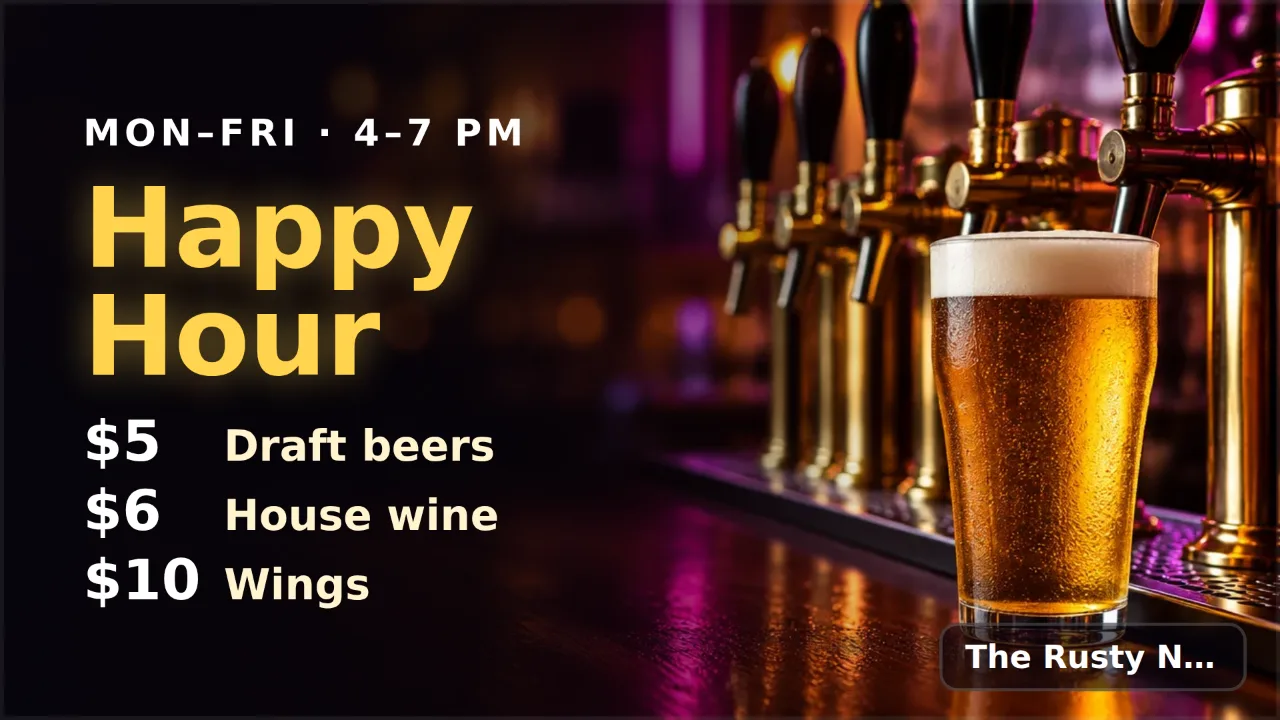
Nightcap is a set of bar games with an AI host that runs on any TV with a browser. Between games, the TV shows your ads. You type the special, pick a background and lettering, and it plays on every TV in the bar on a loop. Your happy hour shows itself at the right hours and comes down on its own. A poster for Friday’s band comes down Saturday. When a game is on, the host reads your specials out loud at the ad breaks, which no menu board can do.
- No media player. The TV’s own browser, a Fire TV Stick, a Chromecast, a laptop, anything that opens a web page.
- No per-screen price. $49 a month for the bar, one TV or ten.
- Updated from your phone in the time it takes to text someone.
- Your posters only. No other bar’s ads, no vendor logo in the corner.
- Included with every game, so a bar that runs trivia on Tuesday gets its menu board for free.
When to buy real signage instead
We would rather you buy the right thing than ours. Get a proper signage system if you need a bright menu board facing a sunny window, a screen in a spot with no TV and no outlet, a video wall, or signs across twenty locations managed from one office. For one bar with TVs on the wall and specials to show, you do not.
Put your specials on your TVs tonight
Start a free 30-day trial, open playnightcap.com on the TV, and type your first special. No card, no player, nothing to install. The games come with it.
Start free → See TV Ads